
Projected vs Actual Release Date
A projected release date is a planning date, not proof that a person will walk out on that day. For Lee County jail custody, the public sheriff current-inmate feed does not publish a universal projected release date. Pretrial release may depend on posting bond, a judge's order, dismissal, a new hold, a probation violation, transfer to ADOC, transfer to another county, U.S. Marshals custody, or ICE. For a county detainee, the official date is usually confirmed after release through the Lee County Sheriff's prisoner book and the order and date of release required by Alabama Code Section 36-22-8.
For state-prison custody, the Alabama Department of Corrections uses the field "Minimum Release Date." ADOC defines that as the earliest scheduled date an inmate can be released to probation or end of sentence. ADOC also warns the date can change if good time is removed for discipline or if the circuit clerk sends new cases or sentence changes. The actual release record may therefore require ADOC, ABPP, Alabama VNS, and the sentencing court, not a single roster check.
Scheduled vs actual release: use the projected date as a lead. Confirm actual release through ADOC, ABPP, VINE/VINELink, Alabama VNS, the Lee County Sheriff's release record, or the court record that applies to the custody type.
How to Find a Projected Release Date
The right search path turns on whether the person is in the Lee County Detention Center, ADOC state custody, or another custody system. The W.S. "Buck" Jones Detention Center active roster is useful for present county custody, but it is not a projected-release calendar. ADOC is the state-custody calculator while a person is incarcerated in Alabama prison.
- Start with the Lee County Sheriff's current inmate search at https://www.leecosheriffal.gov/inmateSearch if the person may still be in county jail.
- Use the current-inmate feed fields at https://apps.myocv.com/feed/rtjb/a7736801/inmatesV2 only as current-custody and charge/bond context. It does not show a universal release-date field.
- Check the Lee County Circuit Clerk at https://lee.alacourt.gov/ and Alacourt ACCESS at https://pa.alacourt.com/ for sentence, bond, probation, revocation, dismissal, or court-order information.
- If the case resulted in an ADOC sentence, search ADOC at https://doc.alabama.gov/inmatesearch.aspx by AIS number or name while the person is still incarcerated.
- Read ADOC definitions at https://doc.alabama.gov/Definitions.aspx for Minimum Release Date, Parole Consideration Date, Parole Status, Jail Credit, Admit Date, Case Number, and sentence fields.
- For parole timing, review ABPP hearing pages and results, then confirm with ABPP because a parole grant still requires home-plan verification and coordination with ADOC.
- Register with VINELink or Alabama VNS where appropriate for custody-change notification, then reconcile any alert with the official release record.
ADOC Minimum Release Date
ADOC's online inmate search is important but limited. It says the database contains currently incarcerated inmates and historical data is not available online. If a person has already been released from ADOC custody, the public ADOC search may not return a current record. While the person is still in custody, the search may expose the state release-date framework, including Minimum Release Date and Parole Consideration Date.
The AIS number is the fastest search identifier because ADOC says it is the unique six-digit number assigned to each inmate. If an AIS number is entered, first and last names are ignored. Name searches are open-ended, and ADOC says only the first 50 matching records display if there are more than 50 matches. ADOC does not include inmates sentenced under the Youthful Offender Act in the public search, so a no-result search does not prove release.
Lee County Jail Credit
Jail credit is the Lee County-specific correction path that matters most for state projected release dates. ADOC defines jail credit as time spent in county jail before sentencing and says the circuit clerk of the sentencing county prepares it. For a Lee County sentence, questions about missing or incorrect jail credit should go to the Lee County Circuit Clerk, not the sheriff and not a generic state lookup. A jail-credit change can move ADOC's Minimum Release Date or end-of-sentence date.
ADOC remains the state-custody calculator, but the local source data for jail credit can come from the Lee County Circuit Clerk. If the ADOC date appears wrong, compare the court case number, sentence date, term, jail credit, and any amended judgment or new case sent by the clerk. The sheriff's jail record can help show county custody dates, but the sentencing court and clerk are the release-date correction route for ADOC calculations.
Good Time and Education Time
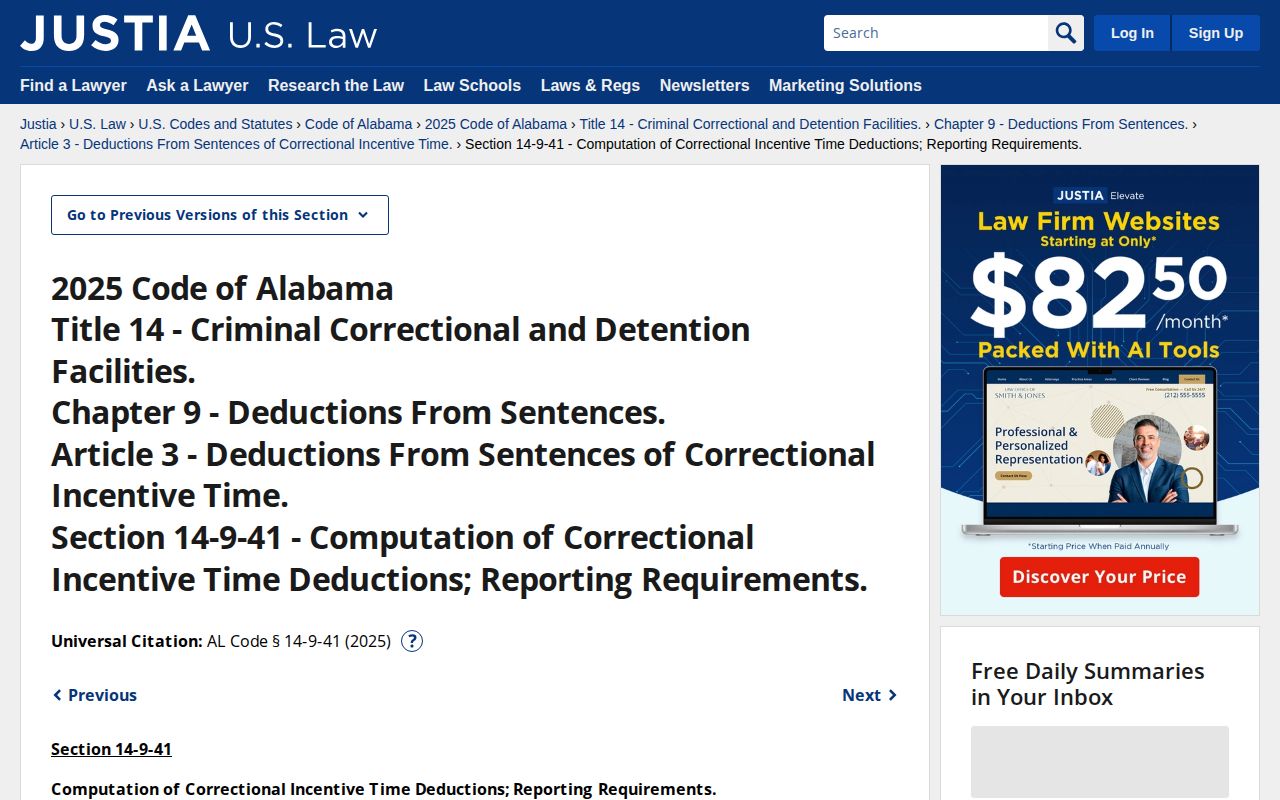
Alabama Code Section 14-9-41 governs correctional incentive time, often called good time. It is relevant to eligible ADOC prisoners, not ordinary Lee County pretrial bond releases. The statute uses classification-based deductions and exclusions. The research notes exclusions for people convicted of Class A felonies, crimes causing death by deadly weapon, life or death sentences, sentences over 15 years, and sex offenses involving children, subject to the details of the statute. The page should not promise that every Alabama prisoner earns good time.
Alabama Code Section 14-9-64 provides education incentive time for qualifying educational progress, capped at 12 months during any term of incarceration. The statute says education incentive time is in addition to other sentence deductions, including correctional incentive time. If it applies, it may alter the projected state release date. It is not a field published by the Lee County Sheriff's current inmate feed, and it is not a basis to calculate a county jail release date without official records.
Mandatory Supervision and Parole Timing
Mandatory supervision is separate from parole consideration. ABPP's FAQ and ADOC's 2023 release explain Alabama Code Section 15-22-26.2. Mandatory release applies to eligible inmates with offenses committed on or after January 30, 2016, excluding child-sex-offense convictions and life sentences. The release window depends on sentence length: three to five months before end of sentence for five years or less, six to nine months for more than five but less than ten years, and twelve to twenty-four months for ten years or more. ADOC determines the mandatory release date and coordinates with ABPP.
Parole Consideration Date is not the same as Minimum Release Date. It is the tentative date set by the Parole Board. A parole hearing may result in grant, denial, continuance, reset, or no reset. If parole is granted, ABPP verifies the home plan and coordinates with ADOC to schedule release, so ABPP says it cannot give an exact release date at the moment of grant.
No Blanket 85 Percent Rule
The Lee County projected-release page should not use a generic "serve 85%" claim. The research did not confirm a universal Alabama rule requiring all Lee County or ADOC prisoners to serve 85 percent. Alabama has voluntary truth-in-sentencing standards under Alabama Code Section 12-25-36, and those sentences include a minimum and extended term with post-release supervision specified in the judgment. Other cases may involve correctional incentive time, education incentive time, parole eligibility, mandatory supervision, split sentences, offense-specific exclusions, and new or amended court records.
The practical rule is to read the judgment first. If the judgment uses truth-in-sentencing terms, use the minimum and extended terms specified there. If the person is in ADOC custody, compare the judgment with ADOC's Minimum Release Date, jail credit, parole consideration information, and any good-time eligibility. If the person is in Lee County jail pretrial, a projected prison-date calculation is premature unless and until sentencing occurs.
Why Release Dates Change
Release dates change because custody records are not static. A Lee County detainee may leave by bond one day and be held on a separate warrant, detainer, or court order the next. A state prisoner may gain or lose credits, receive an amended sentence, or be delayed by parole home-plan verification.
| Change | Effect on release date | Source to check |
|---|---|---|
| Good-time loss | Can move ADOC Minimum Release Date later. | ADOC definitions and records. |
| Education incentive time | May reduce eligible ADOC sentence time. | ADOC records and Alabama Code Section 14-9-64. |
| Jail-credit correction | Can move state projected release earlier or later. | Lee County Circuit Clerk and ADOC. |
| New case or amended sentence | Can add time, change term, or alter release calculation. | Lee County Circuit Clerk, Alacourt, ADOC. |
| Parole grant or denial | May create a supervised release path or reset future consideration. | ABPP hearing results and field office. |
| Hold or transfer | May prevent return to the community even after one custody term ends. | Sheriff release record, ADOC, BOP, ICE, USMS, court. |
Confirming the Actual Release
For an actual Lee County jail release date, request the sheriff's prisoner intake-and-release record through the Lee County Sheriff's records page at https://www.leecosheriffal.gov/recordsrequest. The sheriff's policy requires the public-records form, proof of Alabama residency, and in-person submission at 1900 Frederick Road, Opelika, Alabama 36801. It states a normal 15-business-day response after receipt, subject to extension notice. For release alerts, use the VINELink Inmate Search path.
If the person was sentenced to ADOC, also use ADOC public records, ABPP, Alabama VNS, and the Lee County Circuit Clerk. If a Lee County jail release was really a transfer, use the receiving system: ADOC for state custody, BOP for federal sentenced custody, ICE ODLS for immigration custody, or U.S. Marshals/federal court for federal pretrial custody.